Shape as movement
The shapes of the things we see around us, or in drawings and paintings of things, are all made by movements. The shapes of plants arise from the movement of growing, the banks of a river are shaped by the movement of the water that wears them away. A statue is made by the movements of the tools in the sculptor’s hands, and the shapes in a picture result from the movements of a paintbrush.
If the movement can be described, the shape is defined, and in this way an endless wealth of visible form can be articulated, returned to, explored and deployed in coherent compositions..
Writing pictures
Eshkol-Wachman Movement Notation (EWMN), a method of writing movement primarily of the human body, makes such definition possible. In dance our bodies sculpt the air with the invisible shapes of paths of movement. Here we are proposing the sculpting of visible shapes with the movement of a linkage which is invisible, but comparable to the structure of a body. With this approach as the basis for making compositions of visible shapes, it is possible to pass beyond familiar ‘geometrical’ shapes to more complex configurations without resorting to complex mathematics or to arbitrary patterning.
The basic idea
Movements generate shapes, and – conversely – shapes can be described as the paths of movements.
In principle, any shape can be described as the path of movement of a few links comprising a chain of axes.
Click here for an explanation of Why, and how?
MOTION PAINTING with "DREW"
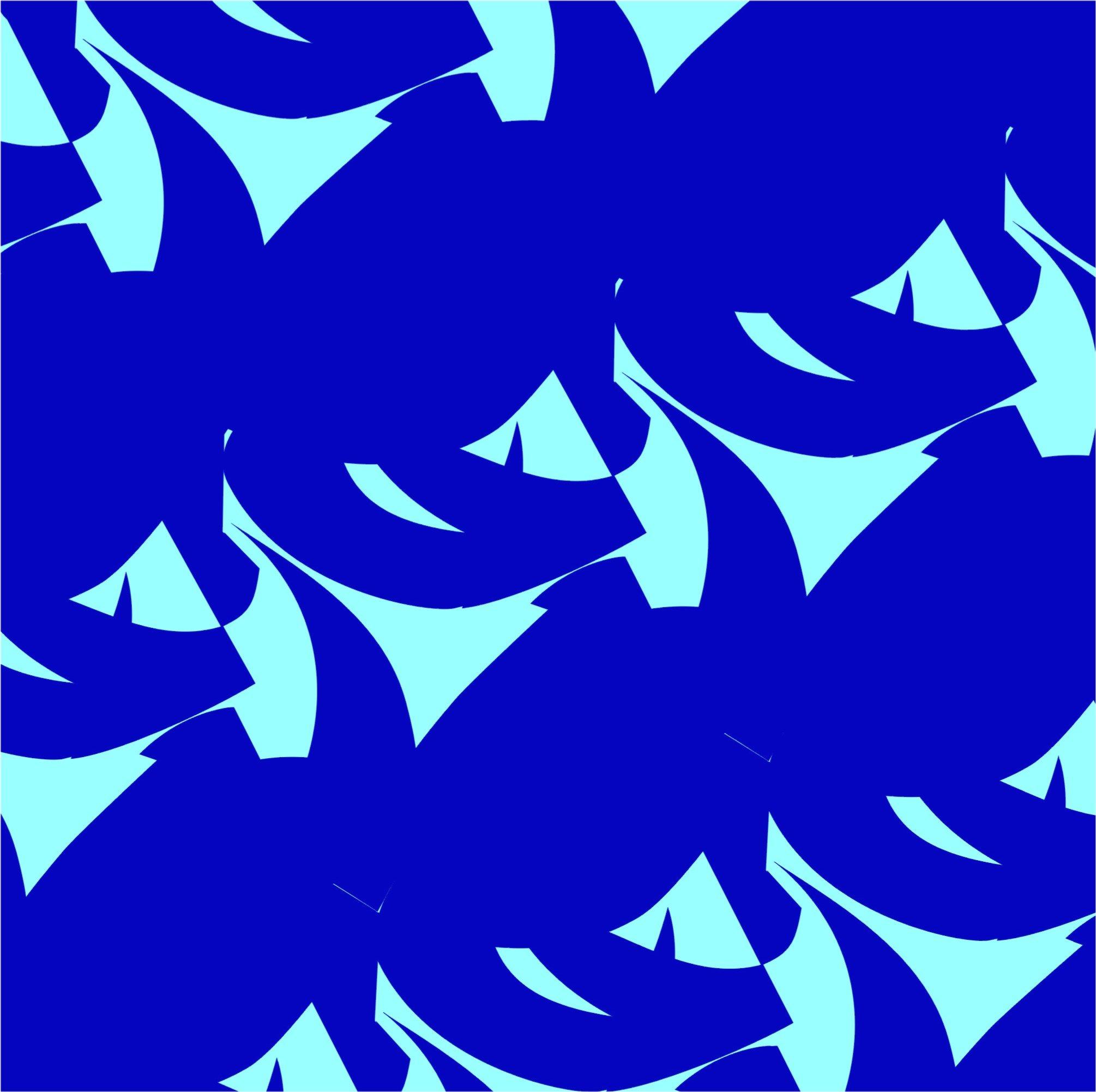
Motion paintings are compositions in two dimensions, consisting of the paths of movements made visible as they create traces which continue to be visible after the movement is completed. Such movements are comparable to brush strokes sweeping out shapes. The moving elements can be articulated to form chains structurally comparable to the articulated axes of a group of limbs of a moving body, and the definitions of the movements are formulated in the terms and concepts of Eshkol Wachman Movement Notation (EWMN). The results are simultaneous ‘brush strokes’, gestures seen as they create integrated traces. These ‘brush strokes’ can be made to change in width or length as they move.
Familiarity with EWMN is an advantage when using the program, but not essential. With this approach, the combined interaction between the individual movements of the links of the chain can be used to describe familiar geometrical shapes and combinations, or irregular formations.
DREW employs the open source Processing platform, which can be downloaded free.
This provides the environment for the motion painting program DREW, and the code for DREW is given below following some basic explanatory notes, and should be copied and pasted into the space provided by the Processing environment.
Explanatory notes
The only part of the DREW code requiring input in order to create compositions of movements and shapes is in the end sections headed SETUP and MOVEMENT INPUT.
Overall settings are made in the SETUP lines.
Note that res (resolution) refers to the angular size of the inter-frame shifts of movement of the FIRST LINK ONLY. (The extent of the shifts of the links that are carried by it is determined by the individual amount of movement of each link relative to the link that carries it.)
The data for a composition is placed following the heading MOVEMENTS - INPUT.
Each horizontal row represents the links in a chain of moving lines that generate (sweep out) a shape.
Each item in a row represents an aspect of (each) linked moving line segment:
First row:
The link's starting position when counted clockwise in degrees from a zero position oriented towards the right on the screen, coupled with
The amount of circular movement of the link around its 'proximal' end - positive (clockwise) or negative (anticlockwise)
Second row:
The character of the trace generated by this movement: 1 = sweep/radial lines; 2 = contour/disc; or 0 = no visible trace
Third row:
The initial length of the link, coupled with
Change (increase or decrease) of the length
Fourth row:
Width of the growing edge tracing a contour line of constant or varying 'thickness', coupled with
Change (increase or decrease) of the growing edge
Fifth row:
For each link, its
Red colour component
Green colour component
Blue colour component
Alpha: transparency of the colour
IMPORTANT: For each "move" instruction, the amount of circular movement of the first link must also be entered as the "extentDegs" value.
For initial experiments amounts of movement of not more than 180 degrees are recommended.
The input for the example given here is for a single movement of an articulated three-link chain of lines.
A second example demonstrates a sequence consisting of two movements of three links. This example employs the same code as the first, but substituting a different INPUT.
The final example demonstrates a single combined movement deploying six links.
This is comparable to the simultaneous movement of an upper arm, forearm and a single finger with its three joints. Each segment can leave a trace of one kind or another, or no trace, as explained in the previous examples.